
Borderline Silence
Year 4; Chapter 26: The Border

The Maple Leaf Ranch sat like a ghost against the star-drunk sky, its buildings dark except for a single light in what might once have been the main house. We crouched in the mesquite fifty yards out, watching, listening, trying to distinguish between hope and trap.
“No movement,” Carlos whispered. “Could be abandoned.”
“Or could be Keisha being careful,” I countered, though my own doubts gnawed like hunger. The message was eighteen hours old now. In this new world, eighteen hours was geological time.
Behind us, the sounds of pursuit had grown closer throughout the night. Military vehicles on the roads, helicopters making sweeps, and underneath it all, the wet hunting calls of things that had once been human. They were boxing us in against the border, using the fence itself as a trap.
“Mama,” Malik’s voice was barely audible, “I see someone.” Everyone perked up, squinting and straining to see into the distance.
A figure moved across the lighted window. Human-shaped, moving with purpose rather than the jerky aggression of the infected. Then the light flicked off and on three times. Off and on. A signal.
“That’s her,” I breathed. “That’s Keisha.”
We broke cover, abandoning caution for the desperate hope of family. Across open ground that felt vast as an ocean, expecting bullets or claws or worse with every step. But the ranch house door opened as we approached, and Keisha’s voice called out:
“About damn time. I was starting to think you’d stopped to sightsee.”
She looked older, harder, wearing clothes I didn’t recognize and carrying a rifle like she’d been born with it. But her smile was the same, and when she hugged me it was fierce enough to crack ribs. When she finally released me, she looked down at her nephew at my side. She kneeled down, holding the door to assist. “Malik, I know you weren’t much of a hugger last time I saw you, how about a high five?” She held her hand up, he pushed past it and gave her the same hug she’d just given me, nearly knocking her down. “I’ved missed you Little Man. I’ll have to start calling you Big Man soon, you’ve grown so much!” That made him laugh. She stood and Malik pulled all three of us together.
“How?” I asked against her shoulder. “How are you here?”
“Long story. Short version: I’ve been running supplies for the underground railroad. This place is a waystation. But we need to move. Border’s about to close permanently, and there’s a strike team five miles out.”
Inside, the ranch house was larger than it appeared, with rooms that had been converted into something between a field hospital and a bunker. Medical supplies, communications equipment, maps marked with routes and dates and the kind of information that could get you disappeared.
“How many?” Keisha asked, assessing our group with professional efficiency.
“Four adults. Plus four kids.”
Precious interjected, “I’m basically an adult now. A few more years.”
“True. You will be counted as an adult, based on your height and weight. I usually only take six max, but factoring in the sizes of these three,” she waved to the children, “we should be okay, just barely. Any injuries? Infections?”
“Everyone’s healthy.” I said, then hesitated. “Keisha, what do you know about the Liberty Virus?” I asked as Carlos and Wei began a private conversation.
Her expression darkened. “Everything I wish I didn’t. Weaponized rabies, essentially. Destroys higher brain function but leaves the predatory instincts. They’ve been testing it in detention centers for months.”
“Testing it on people.”
“On people they’d already written off as disposable. Black children, children of color, mostly. Refugees. Anyone who couldn’t fight back or wouldn’t be missed.” She moved to a radio setup that looked military-grade. “But it’s spreading beyond their control now. Canada’s reported cases in Toronto. Mexico has sealed their northern border. Everyone’s trying to contain what they started.”
“Then how do we get out?”
“Tunnel. Group of us dug over the past six months. Comes out two miles north of Canadian land. But—” She held up a hand as we started to celebrate. “But it’s a one-way trip. Once we go through, they’ll seal it. And if the Canadians decide we’re infected...”
“They’ll shoot us,” Carlos finished.
“They’ll shoot us,” Keisha confirmed. “So we better hope their medical screening is better than their border security.”
She was already moving, pulling supplies from hidden caches, checking weapons with automatic efficiency. “Pack light. Water, medical supplies, documents. Everything else stays here.”
“Including us.” Carlos said. Wei nodded. “My familia is here. We’ll head back to the station. Wei will see if anyone else is in need of transport.”
Keisha said the obvious, “It would give us a little extra wiggle room in there. But you will have to find an alternate route, military’s closing in. Go now or you won’t make it. Scooter in the back, you should both fit.” She turned to finish moving supplies.
“Keisha,” I caught her arm. “How long have you been planning this?”
“Since the first reports of forced injections. I knew they wouldn’t stop with detention centers. Knew eventually they’d come for all of us.” Her smile was sharp as broken glass. “Turns out being paranoid is just good planning when democracy fails.”
Outside, engines were getting closer. The military convoy we’d been fleeing all day, tightening the noose. Through the windows, I could see lights moving in a coordinated search pattern.
“Tunnel’s in the basement,” Keisha said, shouldering a backpack that clinked with extra ammunition. “But first, we have a problem.”
“What kind of problem?”
“Three of the infected are circling the property. Must have picked up our scent.”
As if summoned by her words, something scratched at the ranch house walls. Long, deliberate scrapes that sounded like claws or fingernails worn down to bone. Then a sound that might once have been human speech, distorted by broken vocal cords and alien hunger.
“Windows,” Keisha ordered. “They should be locked but check all of them anyway. They’re smart enough to look for weak points.”
Wei spoke, “May I help myself to ammunition? I’m low.” He and Maria made eye contact. She went over and rested her hand on his shoulder.
“Help yourself to anything you need. Anything that can fit in your pack.” She said but never stopped moving. I saw Wei grab ammunition and a machete. He grabbed an axe and tossed it to Carlos.
We spread through the house, peering through curtains at shapes moving in the darkness. Three figures, as Keisha had said, but moving with pack coordination that suggested they retained some human intelligence. Enough to hunt. Not enough to be reasoned with.
“There,” Precious pointed to the back porch. “One of them found the door.”
The thing that had once been a woman pressed its face against the glass, breath fogging the window as it searched for a way in. Its eyes were clouded white, but its movements showed terrible purpose. It knew we were inside. It was trying to figure out how to reach us.
“Basement,” Keisha decided. “Now. Before they call for reinforcements.”
I took one final look at Carlos first. Then Wei. Wei lifted his sleeve to reveal a long scratch on his arm. My mouth fell open as Maria pushed me closer towards what appeared to be a wall.
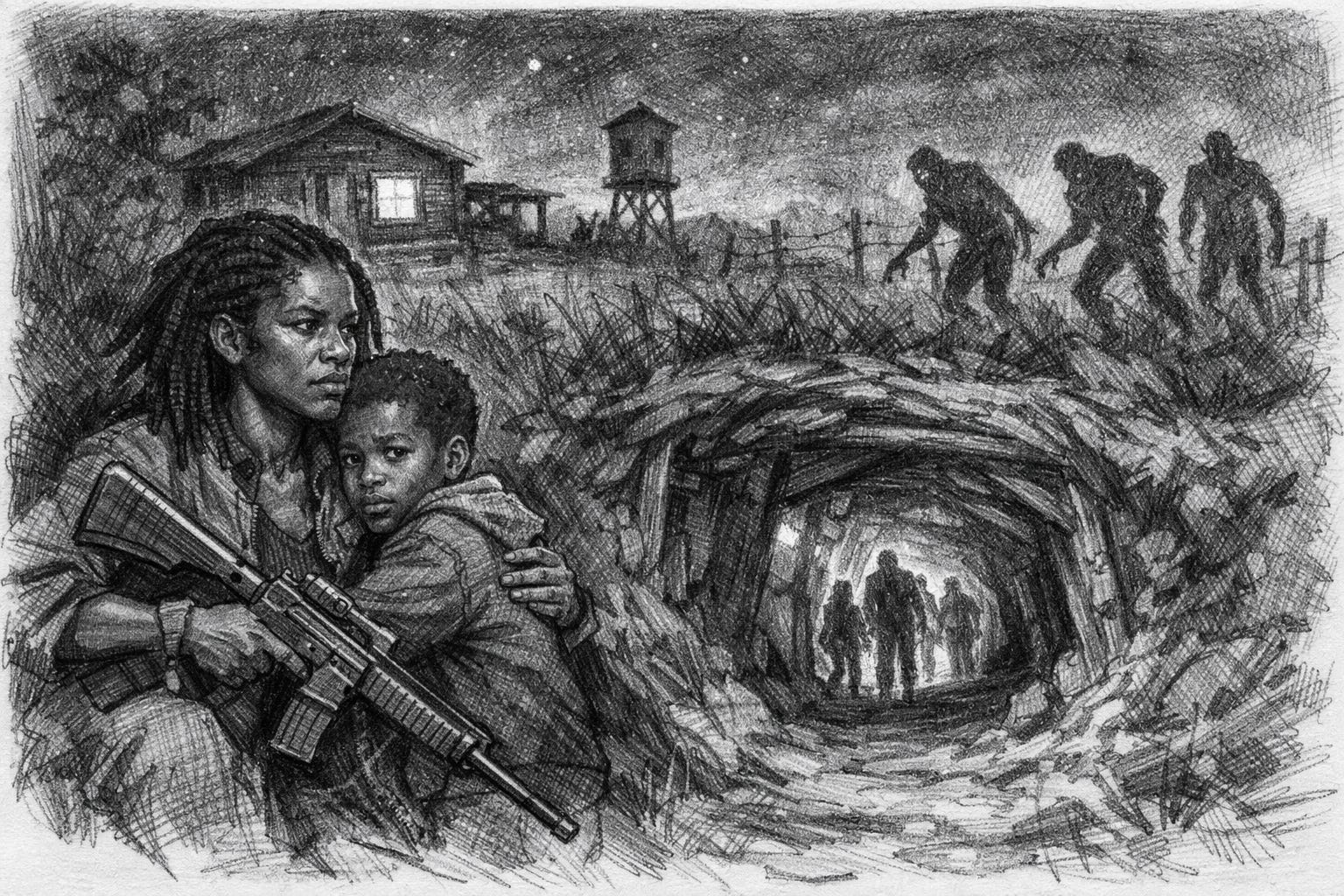
We descended into darkness that smelled of earth and fear and desperate hope. Keisha’s tunnel entrance was hidden behind a false wall that looked like amateur craftsmanship but opened to reveal professional excavation. The tunnel itself was narrow but well-supported, disappearing into blackness that promised either freedom or death.
“I go first,” Keisha said, handing me a flashlight. “You and Malik next. Then Maria and the girls. Carlos would have been the rear. Anyone gets stuck, anyone falls behind, keep moving.
“No one will fall behind.” Maria stated. Nodding at her girls.
Keisha continued. “The tunnel’s rigged to collapse if they follow us through.”
“You’d bury yourself alive?” Precious asked.
“I’d bury them with me,” Keisha corrected. “There’s a difference.”
Above us, something heavy crashed against the ranch house walls. The infected had found a way in, or made one. Their hunting calls echoed through the floorboards, closer now, more excited.
“Go,” I urged. “Now.”
Keisha disappeared into the tunnel first, her light bobbing ahead of us like a fallen star. I lifted Malik, felt him wrap his arms around my neck with the trust of someone who’d never had reason to doubt I’d protect him.
“Adventure time, baby,” I whispered. “Like the dinosaur story.”
“Will there be friends on the other side?” he asked.
“I hope so.”
“Will they think we’re different?”
“Probably.”
“But maybe different can still be beautiful there?”
“Maybe,” I said, stepping into darkness that might lead to Canada or might lead to nowhere. “Let’s find out.”
The tunnel was longer than I’d expected, and narrower. We moved in single file, flashlight beams creating wild shadows on earthen walls. Behind us, Maria reported sounds of pursuit; things moving through the ranch house, searching, hunting, learning.
Halfway through, we heard the first collapse. Keisha had triggered some kind of mechanism that brought down the tunnel entrance. No way back now, even if we’d wanted one. Forward or death were our only options.
Months Later.
“Almost there,” Keisha called back. “I can smell fresh air.”
And then we could too; the clean, cold scent of different air, air that had crossed different borders and carried different promises. The tunnel began to slope upward, and Malik’s weight in my arms felt lighter, as if hope itself provided buoyancy.
We emerged into a forest that couldn’t exist in Arizona. Pine trees and actual undergrowth and the sound of water running over stones. Canada. We’d made it. We were through. Even colder air hit us like another wall.
“Don’t celebrate yet,” Keisha warned, though she was smiling. “We’ve got about ten minutes before someone notices the border disturbance. Need to get to the checkpoint before they send a patrol.”
We ran through trees that smelled like Christmas and childhood and every good thing America had stolen from us. Behind, the tunnel entrance was already camouflaged, disguised as a natural sinkhole that would hopefully confuse anyone trying to follow.
The checkpoint was a simple wooden building with Canadian flags and the most beautiful sight I’d ever seen. Guards who weren’t pointing weapons at us.
“American refugees,” Keisha announced as we approached. “Requesting emergency asylum under the Liberty Virus protocols.”
The guard, a young woman with kind eyes and a French accent, looked us over with professional assessment. “Papers?”
We presented what we had. Documents real and forged, Malik’s birth certificate, my veterinary school transcripts, the accumulated paperwork of lives that had been systematically dismantled.
“Medical screening will take twenty-four hours,” she informed us. “You’ll be housed at the processing center during evaluation. Any symptoms of infection? Fever, aggression, disorientation?”
“Nothing,” I assured her. “We’ve been clean for weeks.”
“Good. Because if you were infected...” She didn’t finish the sentence, but we all understood. The Canadians weren’t taking chances with the virus that was consuming America.
As they processed our initial paperwork, I called the number Keisha had given me months ago. Sarah, in Vancouver, who’d made it out before the walls went up completely.
“Amara?” Her voice was thick with relief and disbelief. “Jesus, I thought... we heard about the camps, about the virus. Are you really here?”
“We’re here. Malik and I, plus some friends. But Sarah, it’s bad down there. Worse than we knew.”
“I know. The government’s finally admitting it’s biological warfare, but only after it started spreading to their own people. Classic fascist overreach. Create monsters you can’t control.”
“Any word on the others? Tanya? Gabrielle?”
Silence. Then: “Gabrielle made it to Mexico City. She’s working with a group that’s documenting the virus origins. But Tanya...” Another pause. “Tanya’s in a Canadian detention facility. They’re calling her a security risk because of her previous arrest.”
My heart clenched. Even here, even in supposed safety, the system found ways to punish those who’d spoken truth too loudly.
“Where?”
“Manitoba. But Amara, don’t try to contact her directly. They’re monitoring communications. Let me work through official channels.”
After we hung up, I sat in the processing center’s waiting room, watching Malik color in a book someone had given him. Around us, other refugees waited for decisions that would determine whether they lived or died. Families torn apart by policies that had started with university admission requirements and ended with literal monsters hunting humans across deserts.
“Mama,” Malik looked up from his coloring. “Are we safe now?”
“I think so, baby.”
“Will we stay here? In the tree place?”
“For a while. Then maybe we’ll go to Vancouver, where Sarah is. Or Winnipeg. Somewhere with good schools and libraries and places to build robots.”
“Can we visit the tree place sometimes? I like the smell.”
“I like it too.”
“Mama?” He returned to his coloring, but I could tell he was thinking. “Do you think Tanya made it somewhere safe too?”
“I hope so, sweetheart. I really hope so.”
But hope and reality were different countries, I was learning. And the borders between them were guarded by people who didn’t always care about the difference.
That night, in a clean bed with actual sheets, I lay awake listening to Malik’s peaceful breathing and wondering about the cost of survival. We’d escaped the monsters, but at what price? How many had we left behind? How many would follow? How many would never get the chance to try?
Outside, it was snowing. Real snow, not the desert dust I’d grown used to. Snow that promised winter, which promised a different kind of hardship but also a different kind of beauty.
“Different can be beautiful,” I whispered to the dark room, to the falling snow, to whatever god or universe had carried us this far.
Tomorrow would bring medical tests and interviews and the slow bureaucracy of becoming officially human again. But tonight, we were alive, we were together, and we were free.
It wasn’t enough. It would never be enough, not while others still ran from monsters that had once been human. But it was what we had.
And sometimes, what you had was everything.
Bravo, this is a wonderful transition point