
Borderline Silence
Year 4; Chapter 27: The Reckoning

Six months later
The letter arrived on a Tuesday that felt like any other—Winnipeg spring, which meant snow in the morning and mud by afternoon. I found it mixed with the usual bills and flyers, recognizing the handwriting before I saw the return address.
Tanya’s handwriting. Unmistakable after all these years, all these borders, all these transformations.
“Mama, I’m going to be late!” Malik called from inside. Nine now, all elbows and energy, more concerned about his science fair project than old ghosts from the desert.
“Coming!” I shouted back, but I stood frozen at the mailbox, holding the letter like it might disappear if I moved too quickly.
The return address was Winnipeg General Hospital, Ward 7. The psychiatric wing. My heart hammered as I tore open the envelope.
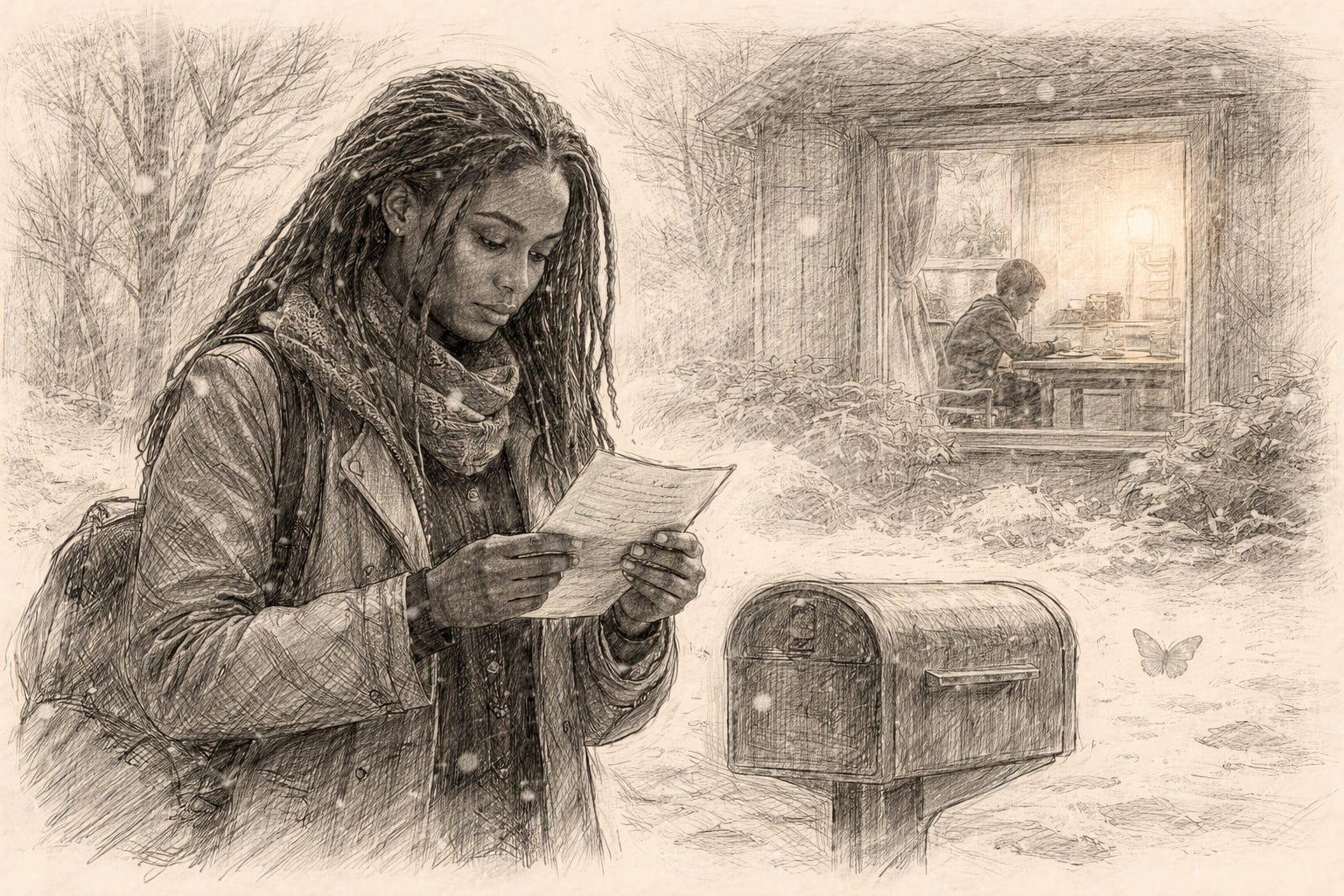
Amara,
If you’re reading this, it means Dr. Patel kept his promise to find you. I don’t know how much you’ve heard about what happened after you left, but I need you to know the truth. All of it.
They didn’t just inject us with the virus. They injected us with something else first. Something that was supposed to make us compliant, docile, easy to process. Most people, it worked. They became zombies in the metaphorical sense; empty, shuffling, grateful for any kindness their captors showed them.
But some of us, maybe 10%, reacted differently. Instead of becoming docile, we became aware. Hyper-aware. I could see the virus for what it was, could feel them changing me cell by cell, and somehow... I stayed myself inside it.
I spent fourteen months as a monster, Amara. Fourteen months hunting humans while my consciousness screamed from inside a body that wasn’t mine anymore. I remember everything. Every person I killed, every family I tore apart, every child who ran from me while I tried to scream warnings that came out as hungry howls.
The Canadians found me three months ago during a border sweep. Dr. Patel’s team has been working with virus survivors. Apparently there are more of us than anyone thought. People who maintained some consciousness through the infection, who can remember and testify to what was done to us.
I’m writing to you because you were always the strongest of us. The one who could see patterns, make connections, tell stories that mattered. And because I need you to know: we didn’t break. Even when they turned us into monsters, even when they made us do monstrous things, we didn’t break.
They’re putting together a tribunal, Amara. International war crimes. The virus was just the beginning. There were other experiments, other atrocities. They need witnesses. They need people who can speak for those who can’t speak anymore.
I know you’ve built a life there. I know asking you to testify means risking everything again. But someone has to tell the truth about what they did. Someone has to say the names of the people who were lost.
Your friend always, Tanya
P.S. Tell Malik his dinosaur story kept me human when nothing else could. Even when I was hunting, even when I was killing, I remembered the brave dinosaur who walked until he found where different was beautiful.
Inside, Malik was struggling with his backpack, science project materials scattered across the kitchen table. Solar-powered robot, designed to clean up microplastics. At nine, he was already trying to save the world.
“Mom, can you help me with this? The motor keeps jamming.”
I helped him troubleshoot the mechanism, my hands steady despite the chaos in my chest. This was what we’d fought for—the right for children to worry about science projects instead of survival, to build things instead of flee from them.
“There,” I said as the little robot whirred to life. “Sometimes you just need to clean the connections.”
“Thanks. Oh, and Mrs. Chen wants to know if you can help with career day next month. She said something about veterinary science?”
I’d completed my DVM the previous year through an extraordinary program Dr. Kim had helped coordinate. She’d transferred all my credits from Sonoran Valley, and Canada’s critical shortage of veterinarians in rural areas had allowed me to complete my final requirements through intensive testing and supervised practice. It wasn’t the path I’d planned, but Dr. Kim had made sure my years of study and exile weren’t wasted. I now worked at a rural clinic outside Winnipeg, finally Dr. Amara Brooks, DVM; a title earned twice over.
“I’ll think about it,” I said.
“Cool. Can I tell her about your robot arm? The one you’re designing for injured animals?”
My current project, a prosthetic leg for a three-legged dog that belonged to one of my clients. Engineering meets medicine meets stubborn refusal to accept that some things couldn’t be fixed.
“Sure. Now go, or you’ll miss the bus.”
He kissed my cheek and bounded out into the crisp morning, backpack bobbing, completely unaware that his mother was contemplating whether to step back into the nightmare we’d escaped.
After he left, I called Keisha at work. She’d found a job with the provincial government, helping other refugees navigate the system we’d barely survived ourselves.
“I got a letter from Tanya,” I said without preamble.
Silence. Then: “Tanya’s alive?”
“She’s alive. She’s... it’s complicated. Can you come over tonight? I need to show you something.”
“Of course. James can watch the kids. Amara... is she okay?”
“Define okay.”
That evening, Keisha sat at my kitchen table reading Tanya’s letter while I made tea neither of us would drink. Outside, Winnipeg went about its peaceful business; people walking dogs, children playing hockey in driveways, the mundane beauty of a society not eating itself alive.
“Jesus Christ,” Keisha breathed when she finished. “Conscious through the whole thing?”
“Apparently. There are others, she says. Survivors who remember.”
“And they want you to testify.”
“They want someone to tell the story. Someone who can connect the dots between the university purges and the detention centers and the virus. Someone who was there for all of it.”
Keisha set down the letter carefully. “What are you thinking?”
“I’m thinking about Malik. About the life we’ve built here. About whether I have the right to risk it all again.”
“And?”
“And I’m thinking about all the people who can’t testify because they’re dead. About Dr. Vasquez and Gabrielle’s parents and Isabella, who’s growing up without her mother because her mother dared to speak truth.”
“Isabella’s in Toronto,” Keisha said quietly. “With Tanya’s cousin. Sarah’s been checking on her. She’s... she’s okay. Scarred, but okay.”
“Does she know? About her mother?”
“She knows Tanya is alive. Sarah thought it was kinder than thinking she was dead. But she doesn’t know about the virus, about what Tanya went through. She’s only eleven now, Amara. How do you explain that to a child?”
I thought about Malik’s easy sleep in the next room, about his robot arms and his faith that broken things could be fixed. How much truth could childhood absorb before it stopped being childhood?
“Show me the letter again,” I said.
Keisha handed it back, and I read Tanya’s words for the third time. The casual mention of families torn apart, of children who ran from her while she tried to warn them from inside a monster’s body. The weight of fourteen months as both victim and perpetrator.
“She’s asking me to help her carry this,” I realized. “Not just testify, but help her live with what she was forced to do.”
“Is that what you want? To carry more weight?”
“I want...” I stopped, surprised by the clarity that came. “I want to finish what we started. All of us, together. The study group that became a resistance that became an exodus. We started documenting the truth when it was still possible to pretend it wasn’t happening. Maybe it’s time to finish that work.”
“The tribunal will be in The Hague. International media, global attention. You’ll be visible again. Vulnerable.”
“I’ve been visible before. We all have. The question is whether visibility serves a purpose this time.”
My phone buzzed. A text from Sarah in Vancouver: “Saw the news about Tanya. I’m flying to Winnipeg tomorrow. We need to talk.”
Sarah arrived the next afternoon looking older, harder, carrying herself with the efficient grace of someone who’d spent years building new lives from fragments. She hugged me fiercely, then stepped back to study my face.
“You’re considering it,” she said immediately. “The tribunal.”
“How did you—”
“Because I know you. And because I’ve been documenting everything from this side, waiting for a chance to use it.” She pulled out a tablet, showed me files upon files of evidence. “Testimonies from survivors, medical records from detention centers, communication intercepts from the Crawford administration. We have enough to bury them, Amara. But we need witnesses with credibility.”
“What about Wei? Gabrielle? Are they willing to testify?” I was hoping she’d heard from Wei since we split before the tunnel six months ago.
“ We lost contact with Wei. Maybe he finally made it to his family. Sarah’s expression darkened. “Gabrielle was murdered six months ago. Mexico City. Made to look like a cartel hit, but the timing was too convenient. She’d just published a paper definitively linking the virus to the injection program.”
Another friend, another loss. The weight of survival guilt pressed against my chest like a physical thing.
“I’m sorry,” Sarah continued. “I should have told you sooner, but—”
“But you were protecting me. I know.” I thought about Gabrielle’s laugh, her nervous energy, her determination to use science as a weapon against injustice. “She would want us to finish it.”
“Yes. She would.”
That evening, I sat with Malik as he worked on homework. Fractions that seemed impossibly complex until you understood the underlying logic.
“Mom, can I ask you something?”
“Always.”
“The stories you tell about before. About the friends who went away. Were they real?”
I chose my words carefully. “Yes. They were real.”
“And they went away because bad people were hurting them?”
“Yes.”
“Are the bad people still hurting people?”
I thought about detention centers that still operated, about refugee camps where families waited in limbo, about the slow work of dismantling systems built on cruelty.
“Some of them. But there are good people working to stop them now.”
“Are you going to help the good people?”
“I might. But it would mean traveling, being away from you for a while. Would that be okay?”
He considered this with nine-year-old seriousness. “Would it help stop the bad people?”
“It might.”
“Then you should do it. I’ll be okay with Aunt Keisha. And Mom?”
“Yeah?”
“When you tell the story about the bad people, make sure you tell about the good people too. About how they helped each other. About how different can be beautiful.”
That night, I called the number Dr. Patel had included in Tanya’s letter.
“Dr. Patel speaking.”
“This is Amara Brooks. Tanya Solano gave me your number.”
“Ms. Brooks! Yes, Tanya has spoken of you often. You were her study partner, I understand?”
“Among other things. She asked me to call about the tribunal.”
“Ah. Yes. You would be an invaluable witness, if you’re willing. Your documentation of the early stages, the systematic targeting of minority students, the connection between academic purges and the detention system—it’s exactly what we need to establish the full scope of the conspiracy.”
“Doctor, can I ask you something? About Tanya, about her condition. Is she... is she herself again?”
A pause. “That’s a complex question. The virus did permanent neurological damage. She experiences episodes of dissociation, moments when she relives the hunting phase. But her core personality, her memories, her moral framework. Those remained intact. She’s perhaps the most remarkable case of psychological resilience I’ve encountered.”
“And the other survivors?”
“Some are doing well. Others...” He sighed. “The trauma of being conscious while committing acts against one’s will. It’s unprecedented. We’re essentially inventing treatment as we go.”
“But they’re testifying? Despite the trauma?”
“Those who can, yes. Because they understand that their suffering has meaning only if it prevents others from experiencing the same fate.”
After we hung up, I sat in my kitchen looking at Malik’s science project, at the pictures on the refrigerator; him playing hockey, our small chosen family at Christmas, snapshots of a life built from hope and stubbornness.
Then I opened my laptop and began to type:
Dr. Patel,
I’ll testify. Not just about the university, but about all of it. The study group, the surveillance, the forced exiles, the camps. The whole chain of causation that led from academic discrimination to biological warfare.
I have one condition: I want to visit Tanya first. Before the tribunal, before the media circus. I want to see my friend.
There are stories that need telling, and some of them can only be told by those who lived them together.
Please arrange it.
Amara Brooks
I hit send before I could reconsider, then sat back to wait for whatever came next.
Outside, snow was falling again. The kind of gentle snow that turned Winnipeg into a postcard, that reminded you beauty could exist alongside suffering, that different seasons brought different possibilities.
In his room, Malik slept peacefully, dreaming whatever dreams nine-year-olds had in countries where democracy still functioned, where children could build robots instead of escape plans.
Tomorrow I’d tell him I was going to see an old friend. That I’d be traveling to help stop bad people from hurting others. That his dinosaur story had traveled farther than either of us had imagined, carrying hope across borders that existed only in human imagination.
But tonight, I sat with the weight of decisions made and unmade, of friendships that had survived separation and transformation, of the stubborn belief that truth. No matter how delayed, how complicated, how painful; was worth telling.
The letter from Tanya lay on the table beside my laptop, creased from handling, precious as any artifact. Proof that love could cross any border, that consciousness could survive any horror, that the study group that had started with anatomy flashcards had become something larger and more enduring than any of us had dared imagine.
We’d been butterflies, scattered by storms we couldn’t control. But butterflies remembered their migrations, passed them down in ways that transcended individual lives.
The tribunal would be our final flight together. Not home. Home was a luxury people like us couldn’t afford, but toward something like justice. Something like truth.
Something like the place where different was not just tolerated but celebrated, where the scars we carried were honored as proof of survival, where children could dream of better worlds without first having to escape the one they were born into.
My phone chimed with a response from Dr. Patel:
Visiting arrangements confirmed for next week. Tanya is eager to see you. She has much to tell you about the others, about friends you thought were lost who are finding their way home.
The truth is gathering itself, Ms. Brooks. Thank you for helping it find its voice.
I closed the laptop and checked on Malik one more time. Still sleeping, still safe, still innocent of the battles that had shaped his childhood from a distance.
“We’re going to finish it, baby,” I whispered to his sleeping form. “All of us together. The story about how different became beautiful, even when the world tried to make it ugly.”
In the morning, I’d start making arrangements. Childcare, work coverage, the logistics of stepping back into a spotlight I’d spent years avoiding. But tonight, I held onto the quiet peace of a Canadian spring, the sound of my child’s breathing, the possibility that justice delayed was not necessarily justice denied.
Outside, the snow continued to fall, covering the world in white that promised new beginnings. Tomorrow would bring what it brought.
Big thank you to everyone that continued reading each week.
This was my first big attempt to write a novel in about 7 or so years.
I think it came out how I imaged it, and I hope you enjoyed it as well.
Please feel free to comment, send a DM, and share.
Thank you so much.
This is marvelous! Is this it? Is this the written ending? If so, what a slam dunk of a novel.